







Rochester's "Green" history
Rochester enjoys both a rich and important horticultural heritage, and an innovative horticultural present.
In the early 1800's, the Erie Canal passing through Rochester made it a trade center between the Atlantic coast, Great Lakes, and the emerging western frontier. Wheat from the surrounding farmland was milled in Rochester and shipped by water from the "Flour City".
The key transportation routes and beneficial conditions of the region led to a rapidly-developing nursery industry. Notable among many was the Ellwanger/Barry nursery, which became one of the world's largest, shipping plant material world-wide, and importing new types for propagation and introduction to America's growing territory. Within a few decades, Rochester changed to be the "Flower City".
In the 1870s Rochester was a leading seed center of America, with the Crosman, Harris and Vick Seed Companies carrying on a mail order business to hundreds of thousands of customers. Rochester had over 35 nurseries in the 1880s, with 30% of the city in nursery cultivation, employing 4,000 workers. Much of the plant material used to establish America's western expansion originated in Rochester.
Horticultural experience and love of natural beauty paid benefits to area residents at the turn of the century, as public parks and private residences incorporated wise plant selection and thoughtful design. Municipal parks were established from land holdings of the nurserymen, with designers such as Frederick Law Olmsted, architect of Central Park in New York City. Recognized as the founder of American landscape architecture, Olmsted's design of Rochester's Highland Park showed his belief in city beautification. Highland is the location of a lilac collection begun in 1892, now featuring over 1,200 bushes in 519 varieties, some hybridized in Rochester. The annual Lilac Festival attracts hundreds of thousands of people to the park each May.
Further north in the city, along river-edge parks also designed by Olmsted, is the Maplewood Rose Garden, an American Rose Society recognized garden with thousands of roses, in beautiful display during the Rose Festival in June.
Rochester has an outstanding urban park system with green space of more than 3,000 acres, 13 percent of total acreage within city borders. Surrounding towns have incorporated varied park land within their master plan, providing a wide range of natural resources to area residents and visitors.
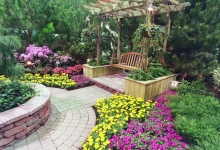
Today, the Rochester region offers homes surrounded with ornamental plantings, majestic trees and flower gardens, tree-lined streets, and a current generation of nurserymen and landscape professionals. The members of the Gardenscape Professionals Association, producers of GardenScape, are upholding the high standards of horticulture around the "Flower City", while pushing the envelope with innovative designs and plant material viewed each year at Rochester's Flower and Garden Show, GardenScape.

